
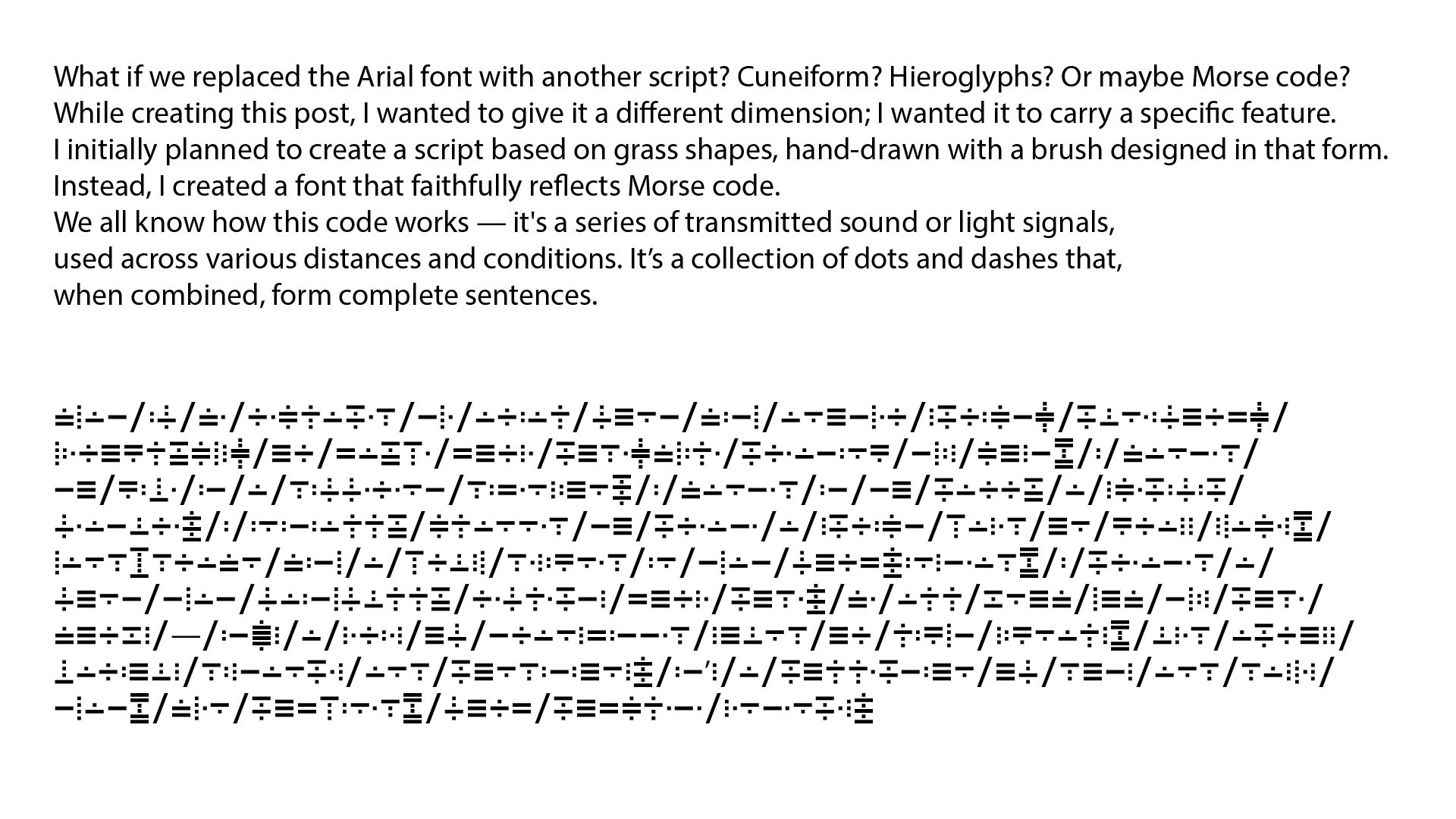
What if we replaced the Arial font with another script? Cuneiform? Hieroglyphs? Or maybe Morse code?
While creating this post, I wanted to give it a different dimension; I wanted it to carry a specific feature. I initially planned to create a script based on grass shapes, hand-drawn with a brush designed in that form.
Instead, I created a font that faithfully reflects Morse code. We all know how this code works — it’s a series of transmitted sound or light signals, used across various distances and conditions. It’s a collection of dots and dashes that, when combined, form complete sentences.
My font was created in FontForge, using settings similar to those in my previous post about the heart-based font. Here, instead of hearts, the font is made up of… dots and dashes.
Given that each character in a standard font occupies a slightly vertical-rectangular shape, I decided to fit each Morse character into the same space, with the design read from top to bottom. In Morse code, characters can contain from one (dot/dash) up to even seven elements. That’s why I arranged the dashes horizontally and structured the reading from the top down — so, for example, the letter „N” is read as a dash followed by a dot from top to bottom.
There are several variants of Morse code, but I chose the most universal one: the International (ITU) Morse Code.
Additionally, I incorporated support for Polish characters, allowing full use of the Polish language. I also included available special characters, although not all of them are defined. For undefined characters in the TTF font, I used an „X” marker.
In a short video, you can see a parallel transition between two fonts, where the space remains… a space. In the TTF file, the space is handled in the standard way (as a slash). I didn’t separate sentences from words.
My main source material was Wikipedia:
https://en.wikipedia.org/wiki/Morse_code
The Morse code font I created is available at:
https://drive.google.com/…/1FPf8RROeTRBwKd0hmgF…/view…
The DMQasc-Morse font is free for anyone interested in testing it on their own. Just download and install it — before writing, simply select it.
There’s only one version: regular, with a slight kerning adjustment so that the characters aren’t too far apart.
If you decide to further distribute the font, please credit the author, in accordance with the rules of redistribution rights.
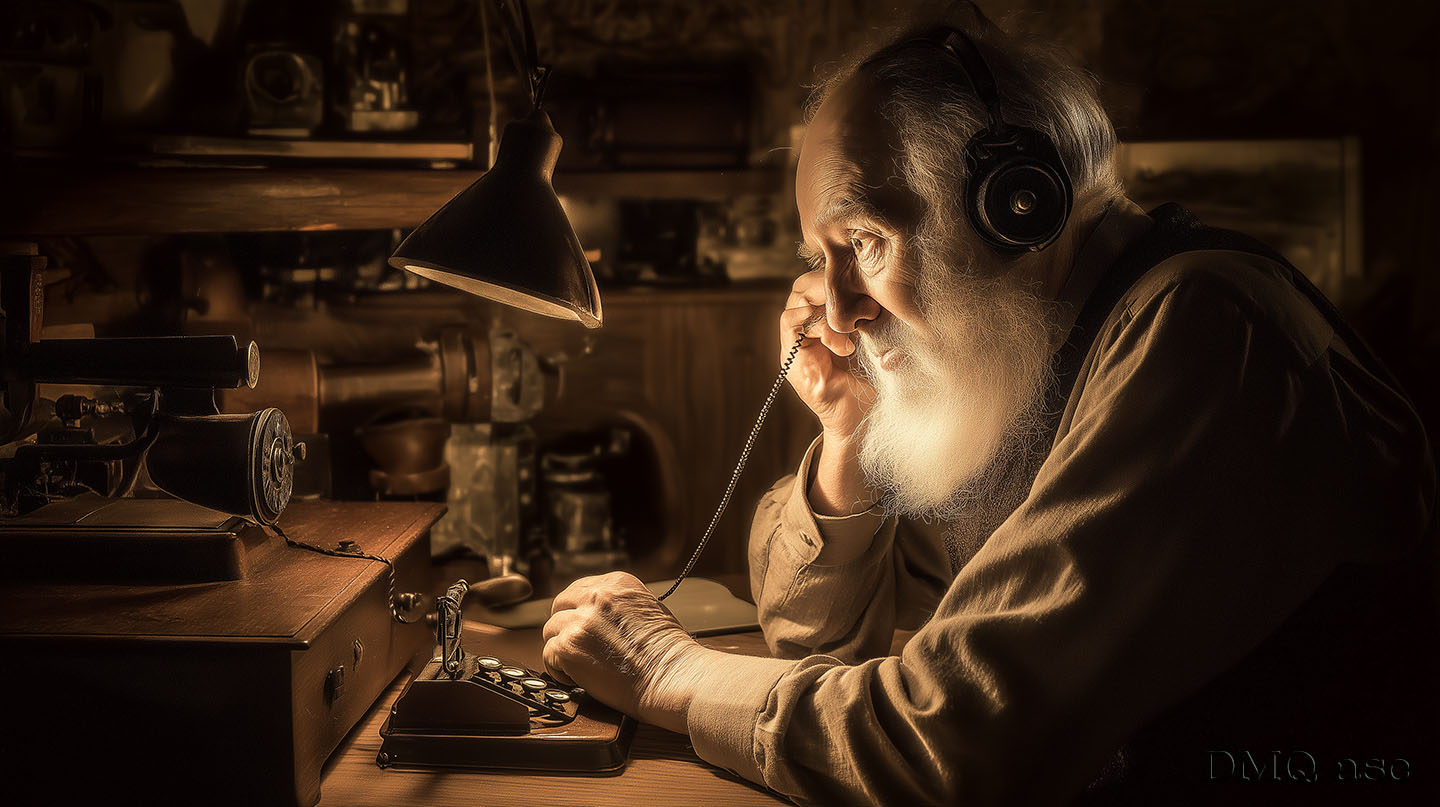
The image for the post was created with Midjourney, the music background was made in Suno, and the special effects were generated using 11Labs.
The selected graphics showcase my skills in transforming the visual appearance of a person, object, or landscape based on the original material. The final result is subjective and represents a specific time frame. Each of us perceives things differently and has a different scope of abilities and timing.
The regularly posted projects with specific themes are aimed at systematically building a collection illustrating graphic capabilities.
Happy testing and viewing!